
All Saints Gobowen
Parking and Accessibility
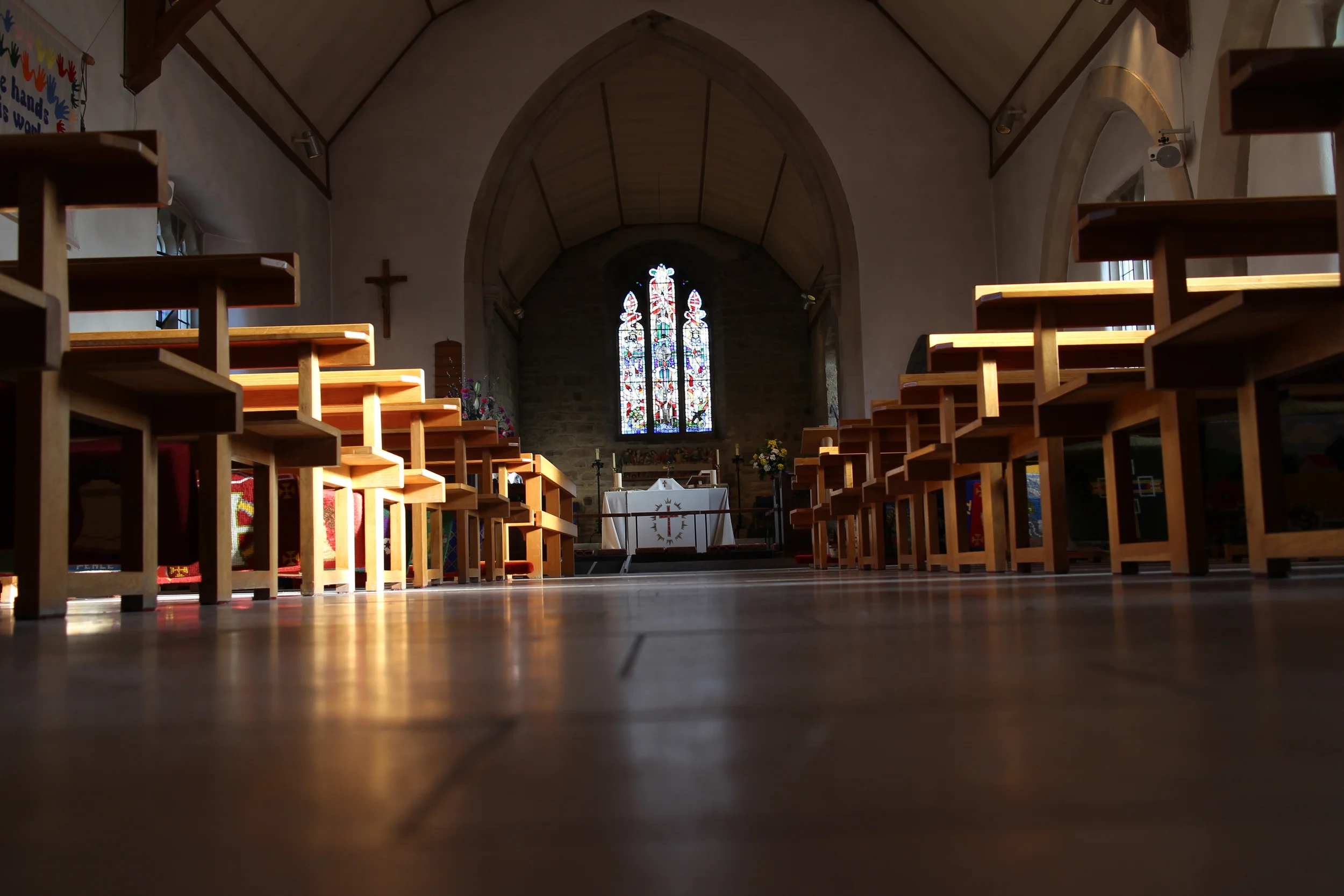
Our building is step free for the main areas so please just ask and explain how we can best help you. There is one step to enter at the main door and at most services and events, a ramp will already be in place.
As you enter the porch, the second heavy door may be closed in winter to keep us warm, but please come in. At services a member of our welcome team will be in the porch to help with the door, or it opens by lifting the metal latch and pulling. We plan, if able, to replace this door with a lighter glass door to aid accessibility and our welcome.
We have a clear sound system including a loop system. There is one toilet in the main church building (through the door by the organ) and additional toilets (including disabled toilet and baby change) in the church hall foyer.
During services, parents with young children are very welcome to stay with us in the service or make use of our family room through the door by the organ. In this room are comfortable chairs, toys for babies and young children and a sound relay so you can still hear the service and be part of the service.
Any words needed in the service are either printed on sheets or displayed on a screen. Larger print copies are available and there’s no pressure to join in if reading at speed is difficult for you.
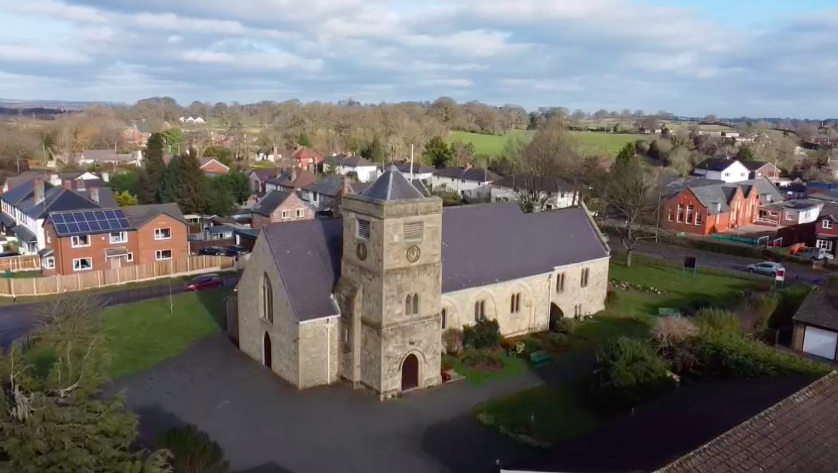
We have car parking spaces just outside the church which are ideal for those with reduced mobility or those with young children. There is plenty of on street parking available around the church too. Our neighbours are very thankful for wise and respectful parking.
Through the Years

An architect impression dated 1919 by Freeman & Ogilvie, London. Note the proposed South aisle was never built.
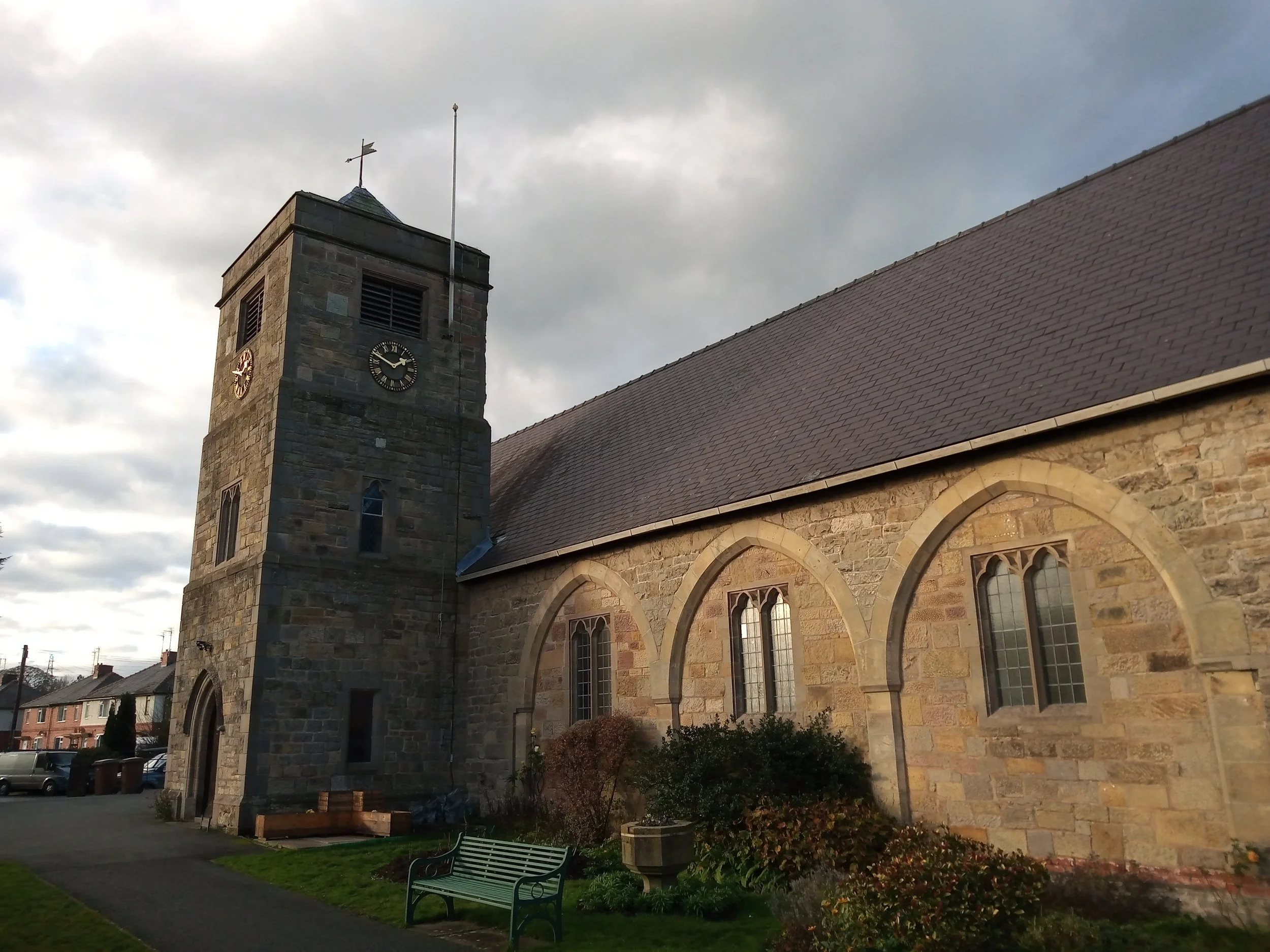
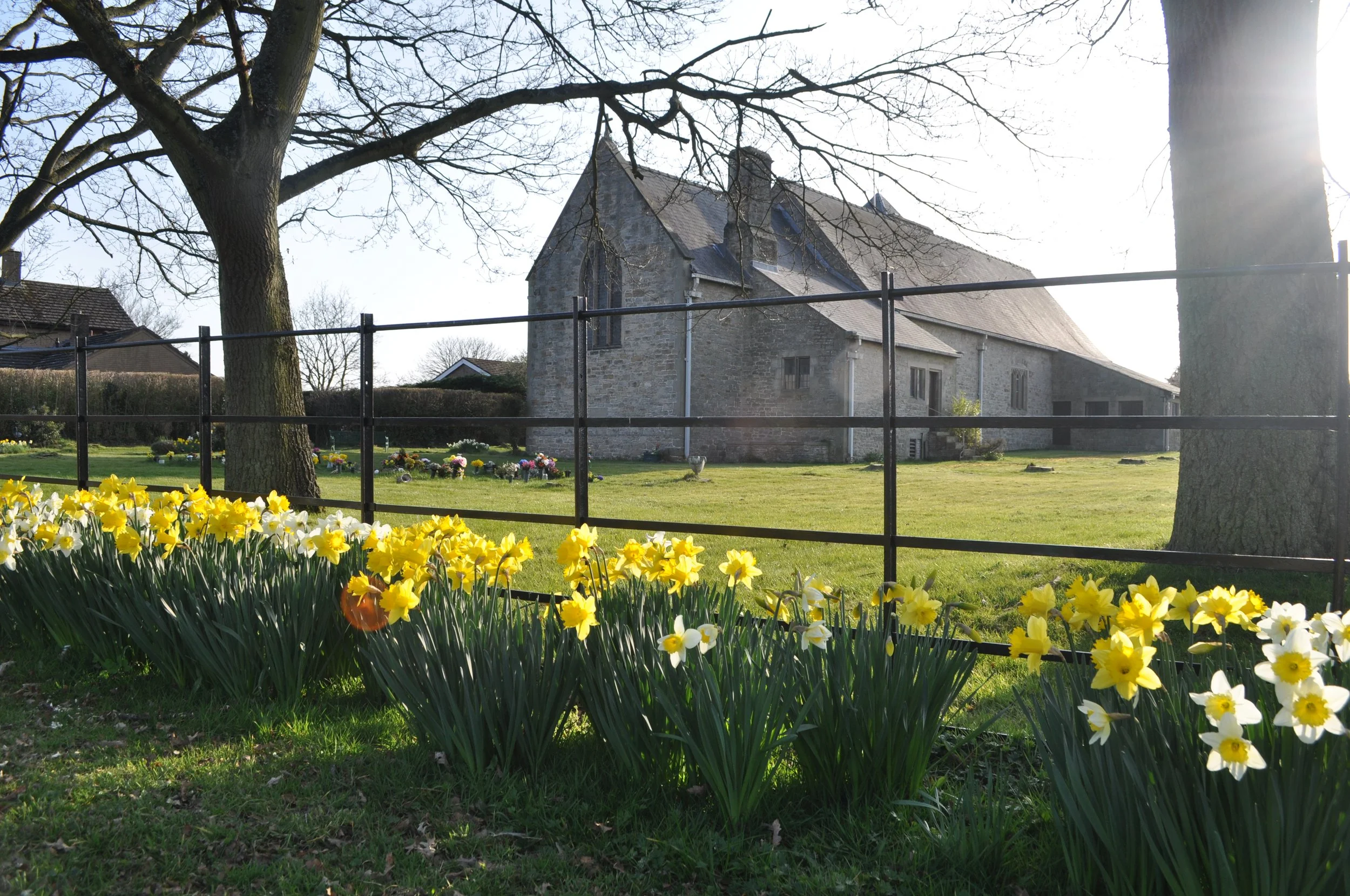
All Saints’ Church, Gobowen, was built in 1928, though the idea was first proposed in 1913. Previous to this, St Barnabas Church, Hengoed, was the parish church, and this is where the designation “Hengoed-with-Gobowen” comes from.
The then vicar of Hengoed was the Rev. G. O. Browne, who was a most remarkable man. When he came to Hengoed in 1885, one of the first tasks was to build a vicarage at Gobowen on land donated by Mrs. Wynne Corrie of Park Hall. This same lady also presented the land upon which the new church of All Saints’ was to be built.
It is perhaps interesting to note that among the names suggested at that time were St. Mary the Virgin, St. Anne and St. Peter. On November 4th 1926 the foundation stone was laid by the Earl of Powis, and the church was dedicated by the Bishop of Lichfield on June 21st 1928.
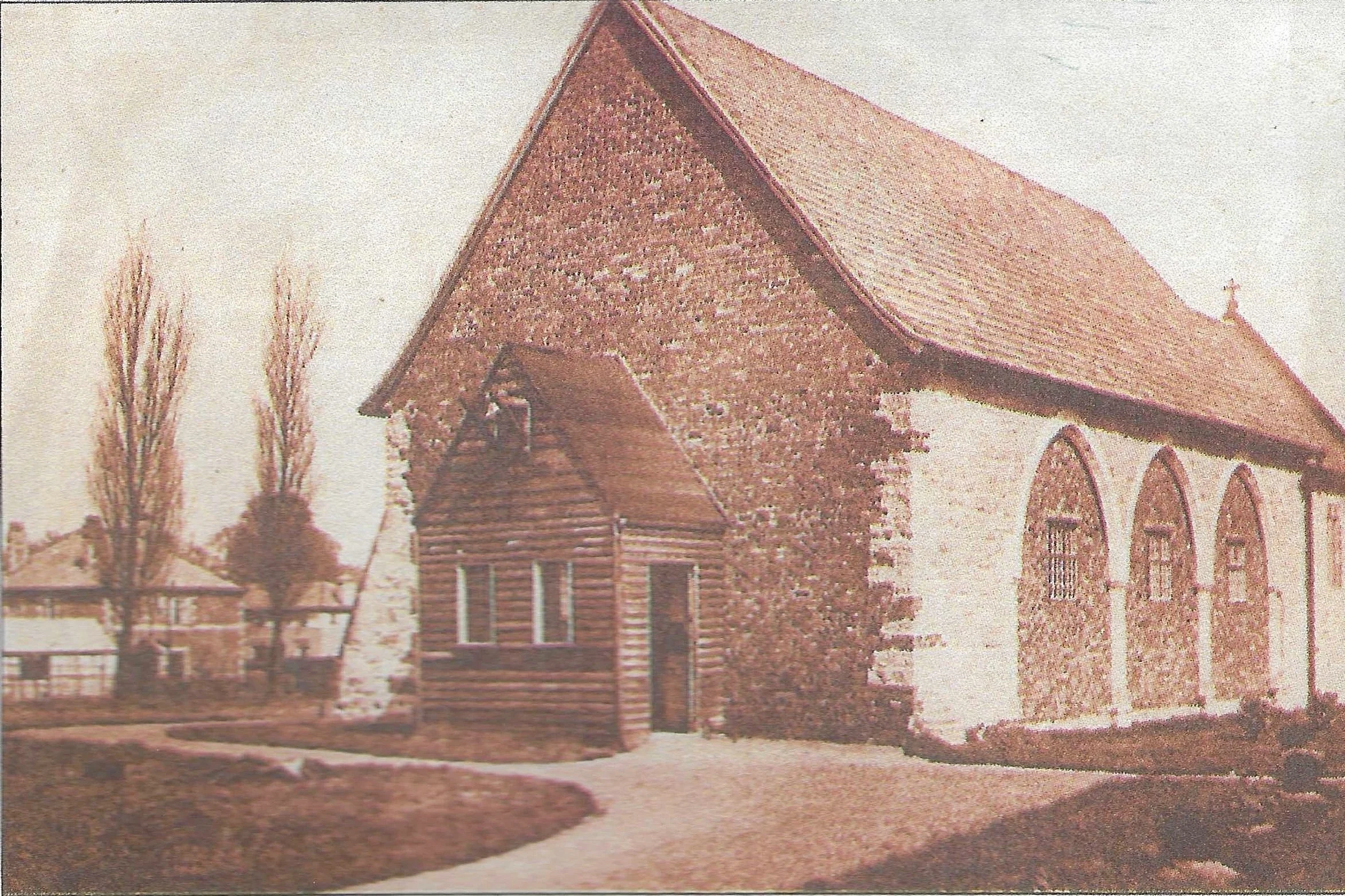
An early photo showing the church without the West End or tower. The South arches were later relaid with stone. (c early 1930s)
By this time, the Welsh Church had been disestablished, and so the parish ‘changed hands’ and went from the Diocese of St. Asaph to that of Lichfield.
When the church was built, only the chancel and the main part of the nave were erected, and included in this was a vestry at the east end. Between 1929 and 1936, the west end was added, and in 1947 the tower porch. The year 1963 saw the creating of an organ chamber and the building of the choir vestry.
The Rebuilding
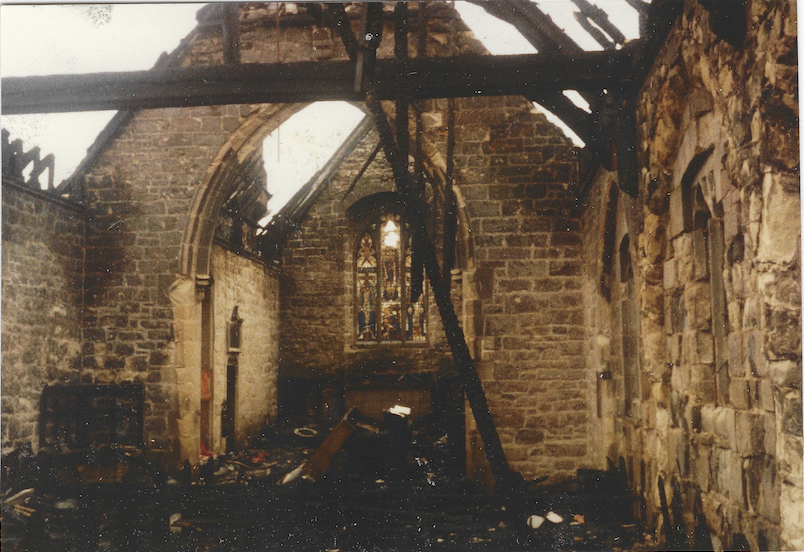
The destruction of the fire 1979. From the nave looking East.
Our golden jubilee was in 1978, when a splendid service was attended by the Bishop of the Diocese, the Rt. Rev. Kenneth Skelton. But the joy so evident at that time was turned to sadness when, on the afternoon of December 27th 1979, All Saints’ was burned down. All that was left was the choir vestry and the four walls.
An appeal was launched for £50,000 and within a short while, thanks to the help that came not only from all denominate within the village, but from friends and well-wishers literally all over the world, All Saints’ was reborn. An impressive service service of re-dedication attended by many of them, and in the presence of Bishop of Lichfield and members of the Roman Catholic, United Reformed, Orthodox and Methodist churches, was held in October 1981.
All Saints’ today is very different from previously in its interior.

A Christmas service (c. 2017)
Because of extensive discolouration of the walls after the fire, these had to be plastered and are now a warm cream colour. The pews are a lighter oak than the old ones. The font and priests’ stalls came from a redundant church in Birmingham, thus showing how new and old can be blended. The floor is of stone similar to that in Belmont Abbey, Hereford. The east window, designed by Lawrence Lee, who was responsible for some of the glass at Coventry Cathedral, is symbolic of the history of the parish, and the explanation on the wall nearby is well worth reading. The west end window came from a redundant church near London, and was given in memory of two devoted members of All Saints’.
The Royal coat of arms was removed from St. Barnabas, Hengoed, which was declared redundant in 1981 when All Saints’ was designated the parish church.
The adjoining church hall was built in 1972, and the new vicarage in 1984. All Saints’ is fortunate in that each of its incumbent has contributed in his own special way, not only to the life of the church but to the Orthopaedic Hospital, the Derwen College and the community as a whole.
Eco Church
Eco Church is A Rocha UK’s award scheme for churches in England and Wales who want to demonstrate that the gospel is good news for God’s earth. A Rocha UK is a Christian charity working for the protection and restoration of the natural world, both as a response to care for the earth, and as a demonstration of the Christian hope for God’s world.
As a church we know that caring for God’s earth is integral to being a Christian. As a member of the Church of England, we recognise the commitment made by General Synod in February 2020, to work towards net zero by 2030, and we have committed to reducing our carbon footprint year on year.
Each church is encouraged to complete an online survey that enables churches to both record what they are already doing to care for God’s earth, and to think about what further steps they can take.
The survey covers five areas of church life:
Worship and Teaching
Management of Church Buildings
Land
Community and Global Engagement
Lifestyle
Please get in touch if you would like to join our Eco Church team or hear more about our work so far and how you can be involved.
You can assess you personal carbon footprint here:

